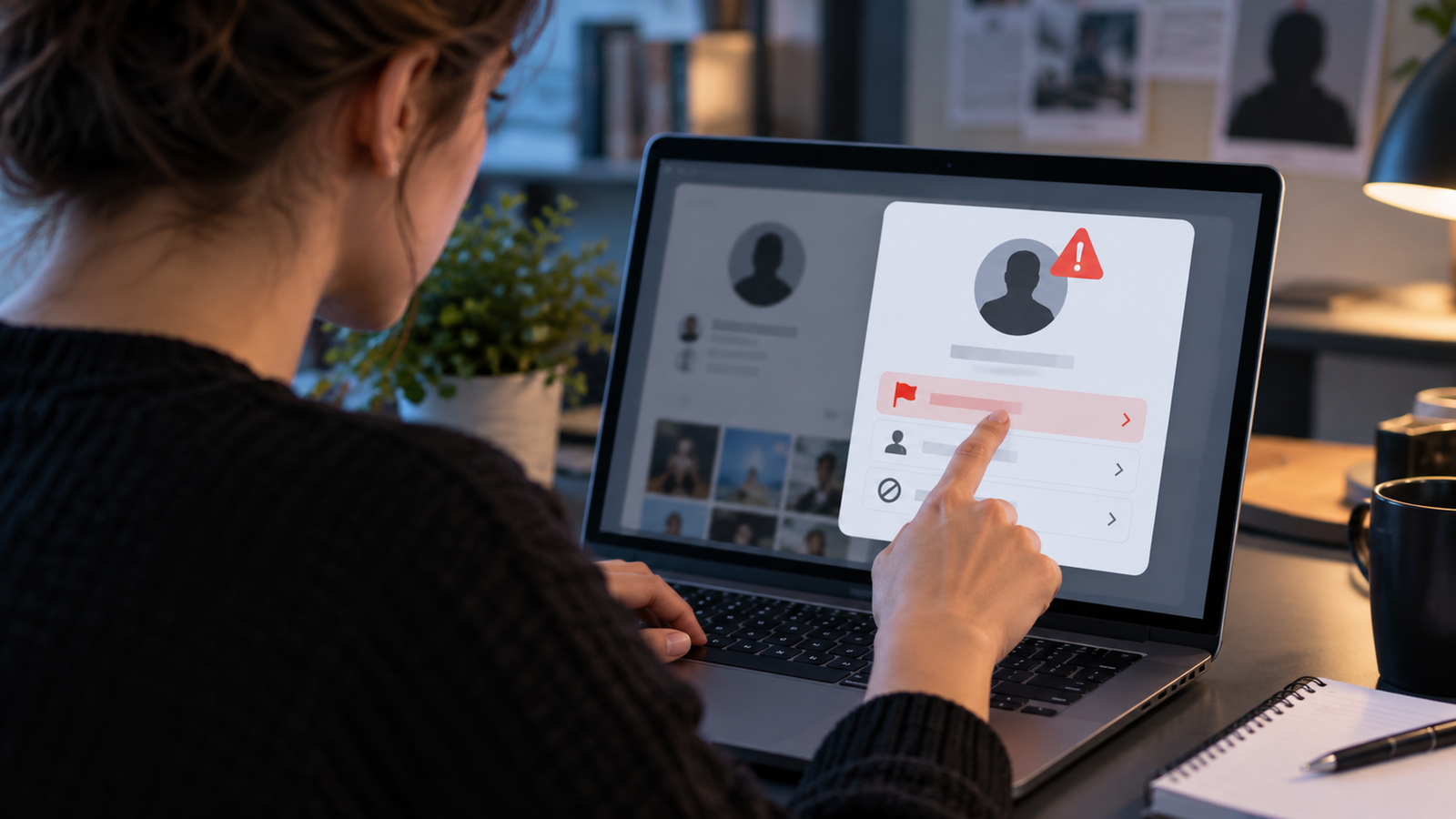
A fake Instagram account can look harmless at first.
Someone copies your name, takes one of your profile photos and creates a second account.
Then the messages start.
Friends receive follow requests from the fake profile. Someone uses your photo to contact other people. In more serious cases, the account publishes private material, adds your phone number, or pretends to speak on your behalf.
At that point, this is no longer simply an annoying fake profile. It becomes an identity and digital-risk issue.
Instagram does not allow accounts created to impersonate or mislead people about someone else’s identity.
The important part is how you respond.
Start by documenting the account before reporting it
One mistake we regularly see is reporting the profile immediately and forgetting to preserve the information first.
A fake account can disappear, change its username or replace its profile picture.
Before submitting anything, save the useful details.
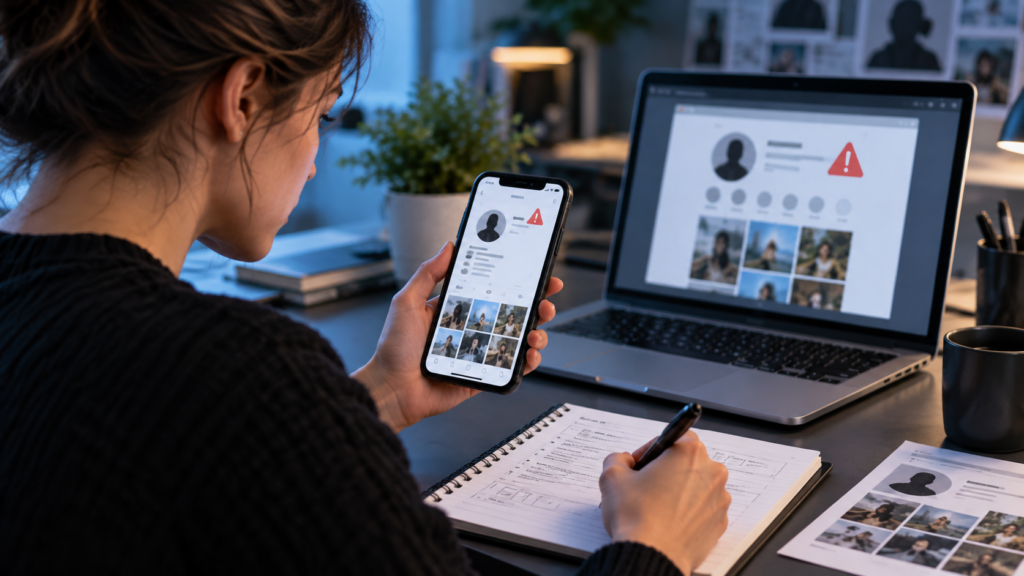
Take screenshots of the profile itself, the username, bio, profile photo and any posts that use your identity.
More importantly, copy the direct profile URL.
A screenshot proves what you saw at that moment. The URL helps identify exactly which account was involved.
If the person contacted your friends or family, ask them to preserve those messages too.
Do not ask everyone to start messaging the fake account. That usually adds noise without helping the report.
Look at what the account is actually doing
Not all impersonation cases are identical.
One fake account may only use your profile picture.
Another may:
- use your full name;
- copy your biography;
- publish your photographs;
- pretend to be your official account;
- contact your followers;
- post private videos;
- publish your telephone number;
- ask people for money;
- make statements while pretending to be you.
That distinction matters because there may be more than one violation.
An impersonation report addresses the fake identity itself.
But if the account is also publishing private content, harassment or other material, those individual posts may need separate reports.
This is often more effective than treating everything as one general complaint.
Make your real account easy to distinguish
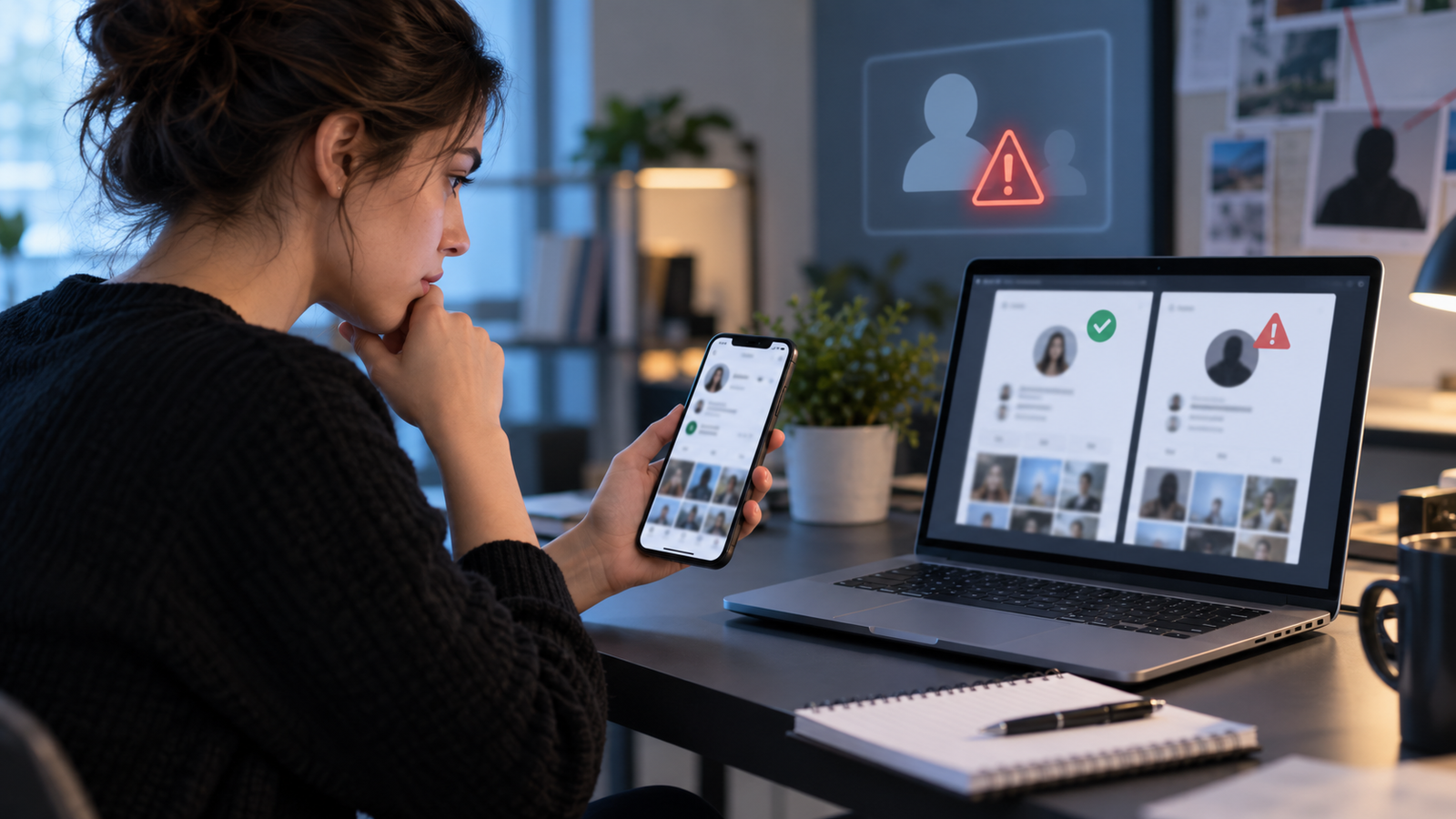
If you still control your genuine Instagram account, avoid making unnecessary changes while the case is active.
Changing your own username, profile picture and display name all at once can sometimes make the situation harder to explain.
Keep your legitimate profile consistent where possible.
If necessary, post a short notice telling your contacts that another profile is not associated with you, but avoid turning the situation into a public confrontation.
The goal is clarity, not escalation.
Reporting the impersonation
Instagram provides reporting mechanisms for accounts pretending to be someone else.
Depending on the account and how you access Instagram, the available screens may differ, so follow the current reporting options shown by Instagram rather than relying on an old screenshot tutorial.
When reporting, make the issue precise:
The account is pretending to be me.
Do not write a long emotional explanation if the form only asks what happened.
Give the platform the information needed to compare the genuine identity with the fake profile.
In some verification or account-recovery situations, Instagram may request additional identity confirmation, including methods such as a video selfie. Meta says video-selfie verification may be used to confirm identity in certain Instagram recovery cases.
Only submit personal identification through legitimate Instagram or Meta interfaces.
Never send an ID document directly to the fake account.
What if Instagram does not remove it immediately?
This is where many people become frustrated.
They submit one report, wait, and assume there is nothing else they can do.
First, check the status of the report when that option is available. Instagram says some submitted reports can be reviewed under Support Requests, although not every report necessarily appears there.
Then review the case again.
Was the report specifically about impersonation?
Are there separate posts violating privacy?
Is the fake profile using your registered business identity?
Has the person contacted other users while pretending to be you?
Those details may require different reporting routes.
Repeatedly sending identical reports without adding relevant information is not necessarily more effective.
A well-documented report is usually more useful than ten vague ones.
If the fake account is using private photos or videos
This changes the situation.
Now there are potentially two separate issues:
Impersonation — someone is presenting themselves as you.
Unauthorized content — they are distributing material involving you without permission.
Preserve the links to the individual posts, reels or stories when possible.
Do not rely only on the profile URL.
If one piece of content is removed but the account remains active, the impersonation problem still exists.
Likewise, removing the account does not necessarily tell you whether copies of the material exist somewhere else.
That is why the wider digital footprint may need to be checked.
Watch for replacement accounts
A removed profile does not always mean the case is finished.
Sometimes another account appears with:
yourname_1yourname.officialyourname_backup
or a completely different username while continuing to use the same photographs.
For a short period after removal, search your name and common username variations.
Also pay attention to messages from contacts telling you they received a new request.
The objective is not constant surveillance. It is simply to catch a second profile before it has time to reach more people.
Secure your own Instagram account
Even when the fake account is completely separate from yours, review the security of your genuine profile.
Use a strong unique password.
Enable two-factor authentication.
Check your email address and telephone number.
Review active sessions.
Make sure there are no unfamiliar devices connected to your account.
An impersonation case and a compromised account are different problems, but sometimes they happen at the same time.
If someone actually obtained access to your account rather than merely copying it, account recovery becomes the priority.
When impersonation becomes a reputation problem
The most serious cases are usually not about the profile picture.
They are about what the fake account does with the identity.
A fake account may contact customers, colleagues, family members or business partners.
It may publish false information.
It may ask for money.
It may combine your real photographs with misleading statements.
At that point, documenting who was contacted and what was sent becomes as important as documenting the profile itself.
For companies and professionals, preserving this evidence can also be important for internal, legal or platform follow-up.
How DERFEND approaches an impersonation case
At DERFEND, the first question is not simply:
“Can this account be reported?”
The first question is:
What risk is the account creating?
We look at the profile, how closely it copies the real identity, what it has published, who it has contacted and whether other fake accounts appear to be connected.
From there, a case may involve account documentation, platform reporting, content-removal requests, digital-footprint checks and monitoring for replacement profiles.
The objective is not only to submit a report.
It is to reduce the possibility that the impersonation continues somewhere else.
One last thing
Do not negotiate with someone simply because they control a fake account using your identity.
And do not send them identity documents to “prove” who you are.
Document the account.
Secure your genuine profile.
Use the correct official reporting channels.
Keep track of any content published under your identity.
If the profile is being used for harassment, private-content distribution or repeated impersonation, the case may require a broader response than a single Instagram report.
DERFEND can review impersonation cases and help identify the appropriate digital-protection and reporting response.
